
Les katakana japonais sont un des trois alphabets syllabaire qui composent la langue Japonaise : les kanji, hiragana et katakana. Les Katakana, tout comme les Hiragana, sont répartis en deux tables et comportent en tout et pour tout 5 voyelles. Je vous donne, ici, une explication sur ce que sont les Katakana japonais et leurs tables.
Les Katakana japonais c’est quoi?
Important dans la langue japonaise, les Katakana (comprendre les kana fragmentaires 片仮名) sont, tout comme les Hiragana japonais, issu d’un isolement d’une partie de kanji dit homophone, et sont apparus peut après les Hiragana.
A la base ils étaient utilisés par les étudiants bouddhistes pour transcrire la prononciation des kanji chinois inconnus.
Les katakana japonais, comment et quand les utiliser ?
Pour beaucoup, les Katakana signifient une utilisation pour les mots d’origines américaine. C’est en partie vrai à l’heure actuelle, mais pas totalement. En effet, les Katakana sont utilisés pour écrire en japonais pour les situations suivantes :
- Les mots d’origines étrangères (pas que les mots d’origine américaine) sauf les mots d’origine chinoise qui ne sont pas considéré comme étant des mots étrangers.
- France : Furansu フランス
- Etats-unis d’Amérique : America アメリカ
- Bière : Biru ビール
- Les onomatopées ou mots courts cherchant à retranscrire une émotion :
- Cocorico : kokekokko コケコッコ
- Gargouillis : pekopeko ペコペコ
- Les ouvrages scientifiques ou noms d’animaux :
- Dauphin : iruka イルカ
- Singe : saru サル
- Donner un effet particulier à un mot d’origine japonaise. On peut par exemple rendre un mot moins « dur » en l’écrivant en katakana. C’est le cas par exemple pour le mot DAME : ダメ qui veut littéralement dire « ce n’est pas possible » mais qui peut être interprété comme étant trop direct ou trop brutal.
La composition des katakana japonais :
Tout comme les Hiragana, les Katakana utilisent les mêmes règles d’écriture :
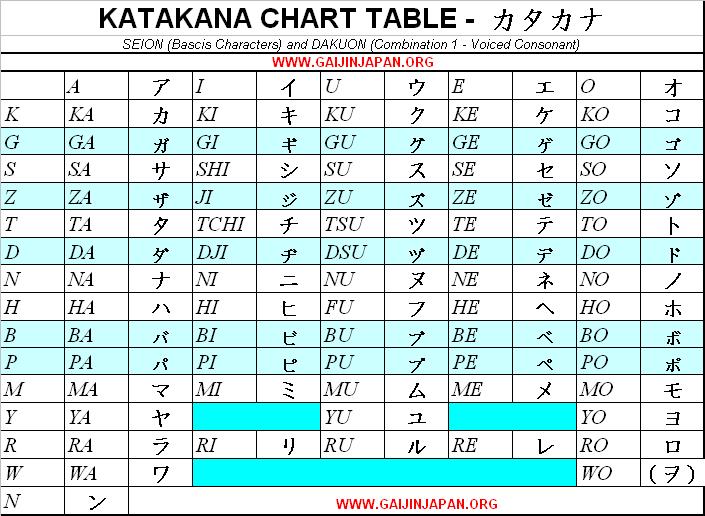
- On ajoutera un DAKUTEN ゛qui aura pour effet de changer les les consonnes « sourdes » en consonnes sonores
- En y additionnant un HANDAKUTEN ゜ on transformera le son H en son P
- L’ajout d’un petit tsu ツ aura pour effet de doubler la consonne suivante. Si vous la prochaine consonne est un P, il faudra lire PP
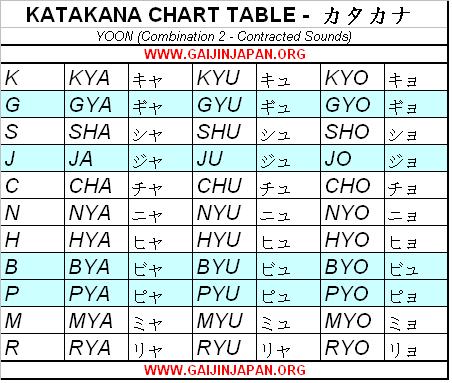
- L’apposition d’un petit Ya, TU, You supprimera le son I et transformera la lecture du Katakana. Par exemple si vous avez un NI + un YA, il faudra lire Nya.
- Un trait horizontal comme celui-ci ー sert à allongé la prononciation des voyelles
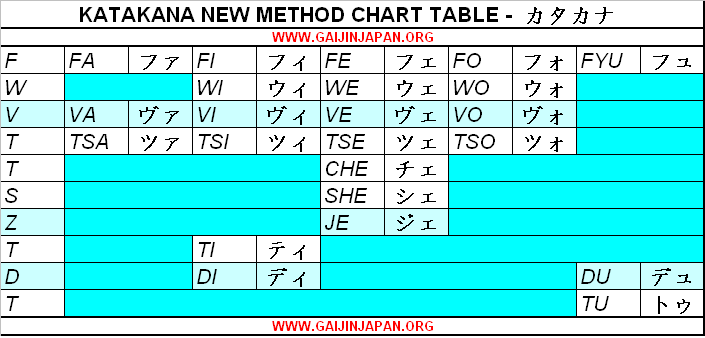
- La langue japonaise ne disposant pas d’un ensemble de sons suffisamment large pour pouvoir prononcer tous les mots des langues étrangères, une nouvelle charte de sons à été créé en utilisant les Katakana, ce qui donne des sons tels que ファ fa, フィ fi, フェ fe, フォ fo
- La lettre V n’existant pas dans la langue Japonaise, le Katakana ヴ est utilisé à sa place et cela donne donc les sons suivants : ヴァ va, ヴィ vi, ヴェ ve et ヴォ vo. Mais toutefois les japonais ne les utilisent pas tant que cela et préfèrent se servir des sons BA, BI, BU, BE et BO.
Au final des mots étrangers retranscris en Katakana sont très nombreux, notamment ceux d’origine anglaise. Cela peu donner les mots suivants :
- Ready : レディ
- Lady : レディ
- Top : トップ
- Christmas : クリスマス
Vous vous rendrez compte qu’il s’agit en faites d’une prononciation japonaise des mots étrangers et non pas d’une prononciation originale. Au final cela peut causer quelques incompréhensions comme sur le mot Ready et le mot Lady qui en japonais se prononce de la même manière (le R en japonais se prononce comme un L, qui lui n’existe pas).
Les tables des katakana japonais :
1ère table des Katakana Japonais: SEION & DAKUON
2ème table des Katakan Japonais: Yoon
3ème table des Katakana japonais: Les nouvelles combinaisons





merci pour ton savoir!!!! le savoir est une lumière!!!
Savoir, je ne sais pas lol… C’est un bien grand mot 😉
Sympa, c’est un peu différent du Chinois malgré tout. Sympa ton plugin yen sinon, ils font ca avec le yuan chinois également?
A bientôt 🙂
Oui c’est un peu différent, mais ça provient entièrement des Kanji chinois (ce sont des parties de ces derniers).
Pour le plugin, oui il le font dans toutes les monnaies, il te suffit de le configurer 😉
Les katakanas sont utilisés pour les ouvrages scientifiques. Intéressant. C’est bien pour tout les ouvrages scientifiques? Par exemple, un essaie en anthropologie ne se ferait qu’en katakana?
Ah très bonne question. Si les termes utilisés ne sont pas d’origine japonaise, en théorie ils doivent être écris en Katakana. Mais ils seront aussi mélangés avec des Hiragana et Kanji pour tout ce qui est mots d’explications. Donc très certainement, seul les mots scientifiques seront en Katakana.
A quand de nouveaux articles dans cette partie du blog? : )
Et plus de détails sur ton école? 😀
J’ai lu que tu voulais attendre la fin de ton cursus, mais des bilans de parcours (tous les 6 mois?) pourraient être intéressant pour voir l’évolution de ton apprentissage
Salut Eupheby,
les nouveaux articles devraient arriver prochainement. En faites, je ne voulais pas encore le révéler, mais je suis en train de négocier avec une école de japonais pour qu’ils me rédige du contenu exclusif et de qualité pour ce blog. Je veux être en mesure de proposer quelques chose de qualité qu’on ne trouve pas ailleurs 😉
Pour le bilan sur mon école, si je ne le fais pas c’est parce que je la fréquente encore. Les responsables de mon école connaissent mon blog et il suffirait que j’écrive une seule chose qu’ils n’apprécient pas pour que ça me retombe dessus (ça m’est déjà arrivé via un partage sur facebook). Donc je préfère attendre la fin de mon cursus pour en parler librement 😉
Ah tu nous réserves du lourd 😀
Hâte de voir ça!
Pour l’école je comprends, on patientera donc : )
J’essaye, j’essaye hein 😉